

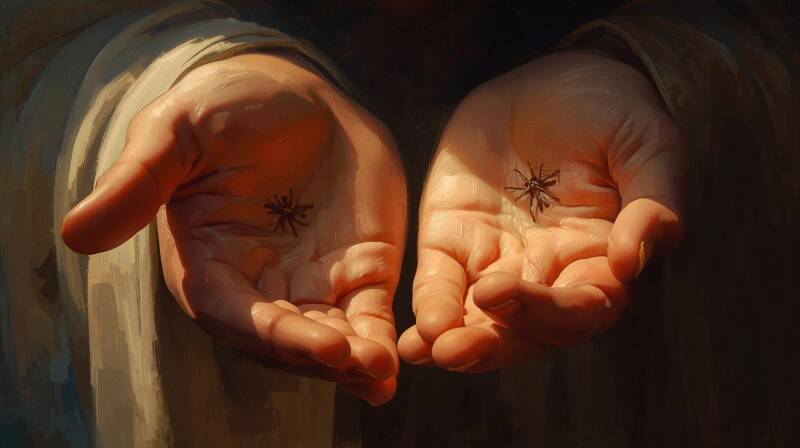
One of the most disorientating things about trauma is not just what you lose.
It’s what you realise you never had.
When my marriage ended, I didn’t just lose a husband. I lost the security I believed was immovable. I had built my life on something I thought was concrete. I thought, no matter what came — ups, downs, storms, failures — we would face them together. That was the vow. That was the safety net. That was the certainty.
In my naivety, in this sinful and fallen world full of fallen people, I felt utterly secure.
And when that security went, it was as though the ground beneath my entire identity cracked open.
Everything I knew to be true shattered in a single season.
Four years on, life is easier. Living is easier. Sleeping is easier. I function. I work. I parent. I survive.
But I still get thrust — without warning — into the hole. The black hole.
Loneliness.
Grief.
The slow, dawning realisation of just how naive I was.
The brutality of this world.
The brutality of human deception.
The consequences of wrongdoing — mine and others’ — and the long shadow they cast.
I am only just learning in my forties what perhaps I could have known in my twenties.
But then — how?
Where does wisdom come from if not from suffering?
How does one gain depth without pain?
How do you understand reality without it first breaking you?
And so I wrestle with the problem of pain.
Or perhaps — the purpose of pain.
As I write this, I am not triumphant. I am not resilient. I am not strong.
I am lonely.
I am grieving the loss of what I had.
And the loss of what I thought I had — but never did.
That is a different kind of grief.
Grieving a love you believed was real.
Grieving romance built on deception.
Grieving intimacy that was never safe.
Grieving the version of yourself who believed it all.
And then facing who you are now.
More fragile.
Emotionally dysregulated on days like this.
A mother who sometimes fails because she is overwhelmed.
A woman who used to cope with everything — and now cannot.
It is heavy.
And it is not a story people want to hear.
I don’t even want to talk about it.
But writing it feels honest.
Because surely I am not the only one functioning on the outside and collapsing on the inside.
We are told to accept.
To move on.
To find peace.
To be happy again.
And I still have hope that I will.
But right now, the grief feels endless.
For the first time in a long time, I have actually allowed myself to cry.
And here is the strangest part.
The trigger?
A Bridgerton binge.
Those beautifully produced, intoxicating, romantic storylines — the longing, the yearning, the obsessive devotion, the being chosen above all others — they touched something in me that clearly is not healed.
It wasn’t just aesthetic admiration.
It was longing.
A longing to be chased.
To be desired.
To be chosen above everyone else.
To be loved so fiercely that someone would risk everything for you.
Avoidance would say: don’t watch it. Don’t trigger yourself.
But perhaps the ache reveals what is still alive.
And then a deeper realisation began its descent — from my head to my heart.
Sex within marriage — that depth of physical, emotional, spiritual intimacy — was never meant to terminate on itself.
It was a signpost.
The closeness.
The vulnerability.
The covenant.
The nakedness without shame.
It was designed to reflect something infinitely deeper: God’s intimacy and covenant love for us.
That realisation does not erase the yearning.
I still long to be loved by a man in that way.
To experience that physical bond and emotional safety with another human being — even in its flawed, earthly form.
But I am beginning to see that the truest version of pursuit has already happened.
When Jesus came to earth two thousand years ago, that was the chase.
When He allowed Himself to be beaten, humiliated, tortured, nailed to a cross — that was yearning.
That was love refusing to let go.
Even when I do not feel pursued by God, the cross stands as evidence that I was.
If we dare to consider the brutality of what He endured — not sanitised, not softened — that is what being chased looks like.
Not flowers.
Not orchestras.
Not a ballroom declaration.
A cross.
Romantic dramas end at the wedding ceremony. The music swells. The couple commit. Fade to black. Happily ever after.
But in a fallen world, marriage is not immunity from suffering. We project salvation onto it. We expect it to heal something only God can.
And so I found myself asking the uncomfortable question:
Why, Jesus, are You not enough right now?
Why am I escaping into fiction to soothe this ache?
Why does cinematic romance feel easier to grasp than eternal promises?
The truth is not that Jesus has stopped pursuing me.
It is that the waiting is torturous.
Scripture tells us there will be a wedding feast.
That the Bridegroom will meet His bride.
That there is a marriage ceremony yet to come — one not vulnerable to betrayal, deception, or decay.
Some days it feels too far-fetched.
Too distant.
Fantasy feels immediate. Tangible. Emotional.
Even though we know it is fiction, it can feel easier to believe in that version of love than in promises written two thousand years ago.
But the cross is not fiction.
The pursuit is not fiction.
And so my final cry, as I pack my bag for another weekend of night shifts, is simple:
God, help me.
Help me believe what You have promised.
Make Your presence tangible in the ordinary and the exhausting.
Heal this broken heart that still aches for earthly romance.
Give me hope — not only that I may love again in this life —
but that my gaze would lift higher.
I go to work sleep-deprived.
Emotionally thin.
Carrying patients, parenting, grief.
And beneath it all, a quieter prayer:
Chase me again.
Remind me I am not unseen.
Remind me that the cross was enough.
And that one day,
the ache will end at a wedding that does not fade to black.
Add comment
Comments